Showing posts with label ministry. Show all posts

Wednesday, 26 January 2022

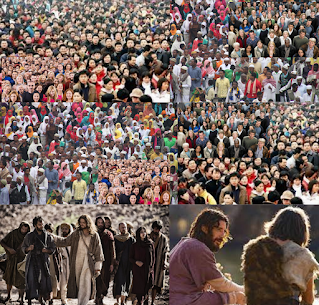
It's all about people - reflections on Matthew 14:13-21

Those who are familiar with this passage would probably remember a sermon or two being preached on it. And the focus was likely to be on the magnitude of the five thousand (and more, including women and children). After all that's what the heading says - Jesus feeds the five thousand. However, it actually starts off with Jesus mourning John the Baptist's death.

So while reflecting on this episode I realised that in ministry we meet different categories of people, just like Jesus did. 

Original collage (see below for image credits)

There are the precious few likeminded ones whom we may not need to say much to yet know exactly what we mean and how we feel. Even though Jesus and John the Baptist had very little time together, I'm sure they were constantly in each other's thoughts and prayers. We draw mutual strength and encouragement just by knowing that we are there for each other.

Then there are those who follow in our footsteps, the ones we teach, coach and mentor. They may not take over our ministries but they are certainly a big part of the legacy we leave behind. In fact, our disciples may do even greater things (John 14:12) because we have patiently sown into their lives.

Of course, there will be the people whom we minister to. We may not necessarily have a close relationship with them, unlike the earlier categories. They may seek us out like the crowd did Jesus, or sometimes God may lead us to find them (eg how Jesus went to Simon's house and healed his mother-in-law cf. Luke 4:38-39). Regardless of how He met them, Jesus always had compassion for them.

Do you have people around you who fall into these categories? Then we would do well to consider how Jesus related and responded differently to each group of people and learn from Him.

Image credits:
  1. Jesus and John the Baptist taken from a scene in the series "The Chosen"
  2. Jesus and the twelve disciples taken from a scene in the movie "Son of God"
  3. crowd photos

Friday, 13 April 2018

Great in me

During a recent prayer meeting in church, the leader said something about God being great in us and it got me wondering, "How does God become great in us?" And immediately, a question popped into my head, "Will you allow God to be great in you?"

The thing is, at the beginning of this year, I had looked at all the assignments and projects for the year and thought that my plate was pretty much full. So I decided I wouldn't take on anymore work. But soon after that, an offer came to do some academic writing and I couldn't refuse as it's something I've grown to love during the two years in Bible college! I thought this must be it, no more after this! However, God has proven time and again that whenever I say never, I would soon come to regret it. A week before the said prayer meeting, He had shown me a need and directed me to offer myself to meet that need. I've learnt not to struggle for too long because He always wins me over, so I said yes.

And God started to show me the answer to the question, "Will you allow God to be great in you?" If I only venture to do the things that I can cope with on my own strength, then I don't need God in me to accomplish all that. But if I obey His directions to take on tasks that are beyond my abilities, then I would only be able to work through them if God works through me. Therefore, when I become weak when faced with those insurmountable challenges, and His power in me helps me to overcome them, God becomes great in me!

In fact, when I look back, I see how this has happened many times in my life whenever I yield to His leading and attempt incredible things. Like when He told me to quit my job and be a fulltime mom. I had absolutely no idea how to take care of babies and children, cook, and do housework (my mom is a progressive who didn't believe that her daughter's place should be in the kitchen!) But He not only enabled me to learn to take care of my family, He also led me to mentor other moms. Even older moms sometimes look to me for advice on parenting!

And then when I thought I had gotten my act together, He told my husband and I to start a music ministry from scratch, outside the church, without any finances and personnel other than the two of us. To cut a long story short, after just about five years, we had reached out to tens of thousands of youth and had a team of over a hundred volunteers!

Which was when He told us to drop everything and undertake a postgraduate course in a Bible college in the UK. We had neither the money nor the brains for it. After all, the only reading I had done in more than 10 years were the Bible and books on parenting. We also didn't have any prior theological training. Plus, how were we to move our whole family to the UK? What would we do about the children's education? Well, again He worked in and around us and now we have come back from the UK to Singapore, with our Masters degrees! In addition, the children slipped right back into the schools here and performed marvellously well in their national exams.

I am not saying all this to boast about our achievements and success. In fact, I'm boasting about how weak I had felt every time He called me to something seemingly impossible. Yet, each time He said, "My grace is sufficient for you." And when I had struggled enough and eventually said yes to Him, I allowed Him to be great in me and His power worked through me to do whatever He wanted. So, will you also allow Him to be great in you?

Monday, 5 March 2018

Transforming Youth and Children's Ministry from "Limited Church: Unlimited Kingdom"

Rob Rienow explains God's design for ministry and evangelism to youth and children in his book, Limited Church: Unlimited Kingdom.

SO WHAT HAVE WE LEARNED?

Through the last century of modern youth and children's ministry we have learned what we are looking for is:

  • A low "leader-to-child ratio"
  • A person who will disciple a child for the long haul
  • A person who loves the child with all their heart and is willing to sacrifice everything to lead them toward godliness
  • A person who has day-in, day-out experience and skills working with this age of child
  • A person who has authority from God to require obedience from the child.
Does this sound like someone we might know? A parent! All the things we are looking for in our church-based ministries God has already built into the institution of the family, and the parent-child relationship.

BUT WHAT ABOUT KIDS WHO DON'T HAVE CHRISTIAN PARENTS?

I can hear you. "Rob, this whole model where the church equips Christian parents to disciple their kids is great for all the Christian families, but what about all the unsaved kids who don't have parents to disciple them?" This question is of the utmost urgency and importance.

As a first response, I need to address the assumption in the question. The assumption is that our modern ministry is radically effective evangelistically.

I once gathered together my team of ten paid youth ministry staff and asked them a question, "Can you give me the names of students who have come to Christ in this last year?" I didn't want names of students who checked a box on a card. I didn't want names of students who were on fire for a month and disappeared. I wanted the names of students who a year ago were lost, in families that were lost, and who were now converted, walking with Christ, and meaningfully connected with the church.

The response? At first, silence. Everyone was racking their brain trying to think of a student who was a new believer. This was in the context of five hundred active students from 7th-12th grade. This was in the context of a ministry dedicated to outreach and evangelism. We were blowing the doors off. Many events were standing room only. Yet, we were struggling to come up with specific students who we knew had been converted. After more thought, we identified five students who we believed were new converts. Five out of five hundred.

So my first response to the question of reaching unsaved youth is to challenge the assumption that what we are currently doing is effective. While God uses fallen people and flawed methods (thank you, Lord) to advance His Kingdom, we should not be at all satisfied with the evangelistic effectiveness of our current ministry model. People are dying apart from Christ and going to hell, and through our ministry model we see precious few saved! We must return to God's methodology, not only because it is His, and not only for the sake of our own children, but for the sake of the lost as well.

I set out to interview these five new believers. I wanted to find out what happened to them. What was their story? How did God take them from darkness to light? Many of their answers would not surprise you. God brought them a Christian friend. They attended a couple of youth group events. They heard some portions of Scripture. But there was a common thread. Each of these five (and I realize this was not a Barna study) not only had a Christian friend, but they were meaningfully involved in their Christian friend's family life. They went on trips with them. They frequently were over for meals. They could walk in the front door without knocking, because they were so welcome in that home. They saw love, forgiveness, grace, joy, and the gospel in action.

I asked them, from their perspective, what had the greatest impact on their journey toward Christ. They all said in their own words, "being a part of that family." At that time I didn't understand the doctrines of sufficiency and jurisdiction, but my view of "child and youth evangelism" changed forever. Before that time, I thought the responsibility for reaching unsaved youth rested with Christian young people (through peer-to-peer evangelism) and with the local youth ministries.

I am now convinced the responsibility for child and youth evangelism is an "all-hands-on-deck" mission for every family in the local church. As a father, it is not my job to simply say to my children, "You need to be sharing Christ with your friends." Instead, God calls us to minister together as a family by opening our home to children in the neighborhood. Our family is a powerful evangelism and outreach center. This is not because we are super-spiritual, but simply because we are Christians.

If we are going to get serious about reaching children who don't have Christian parents, we need to unleash every single one of the local church's "satellite ministries." But Rob, we don't have any satellite ministries. Yes, you do! They are called homes.

My second response to the question of reaching unsaved children is we have dramatically over-estimated the evangelistic impact of church programs, and dramatically under-estimated the evangelistic impact of the Christian family. Imagine if the parents and grandparents in your church stopped looking to the youth ministry to reach the unsaved students in the community, but took the responsibility to intentionally welcome their children's friends into their homes with the goal of reaching not only them, but their entire family for Christ!

Here is the third response. One of the reasons we do not see many unsaved students coming to Christ is because the majority of our focus in Sunday school and youth group is on Christian students. If your church is like most, the majority of children in Sunday school are from church families. The majority of students on your youth group retreat are from church families. The leadership of the church, along with the parents, are expecting the youth and children's leaders to disciple the church kids! As a result, most next-generation ministry leaders are overwhelmed with all of their relationships and discipleship with children who come from Christian homes. This leaves precious little time for serious outreach to the unsaved.

This seems counter-intuitive, but an essential key to accelerating youth evangelism is for a church to embrace the biblical model of home discipleship. When this happens, the youth and children's ministry team is no longer expected to disciple the Christian children from the Christian homes! Instead, in accordance with God's Word, parents are trained and equipped to disciple their own children at home. When this happens (1) every Christian home grows in its mission of becoming a discipleship and evangelism center and (2) the youth and children's ministry staff at the church are freed up to get out of the church building and launch evangelistic initiatives out in the community. We cannot wait any longer to embrace the biblical model, for the sake of our own children, and for the sake of the lost.

Other excerpts from the book:


Sunday, 18 February 2018

God’s Call To Fathers from "Limited Church: Unlimited Kingdom"

From Limited Church: Unlimited Kingdom by Rob Rienow:

In… Ephesians, God gives a Great Commission calling to fathers.

“Fathers, do not provoke your children to anger, but bring them up in the discipline and instruction of the Lord.” - Ephesians 6:4

Fathers are to take the lead in passing faith and character to their children. What is God’s primary plan for children to be evangelised and discipled? Fathers. God did not create the institution of the local church to take over or replace His calling for fathers to disciple their children at home. Rather, the early Christian churches trained and equipped fathers for their “disciple making ministry” at home. Ephesians 6 is a specific example of this training. Ephesians, along with the other letters of the New Testament, were read as sermons in first century churches. These words were spoken from the pulpit to fathers: calling, challenging, and instructing them how to embrace their mission to disciple their children.

God gives men two vital words here if they want to impress the hearts of their children with a love for God. Fathers are to bring their children up in the discipline and instruction of the Lord.

The word discipline here means far more than correcting wrong behaviour. It is a word that connotes systematic training and action. One might think of teaching a child the “discipline” of karate. The child engages in wide variety of training activities, which in the end lead him toward becoming an expert in karate. In the same way, God calls fathers to take the lead in the spiritual training of their children. Fathers are to pray with their children, worship in church with their children, and serve their neighbour with their children. Fathers are to practise the disciplines of the Lord with their children.

But fathers are not only commanded to practise their faith with their children, they are commanded to bring them up in the instruction of the Lord. Echoing the Great Commandment in Deuteronomy 6, God calls fathers to talk with their children about the things of God. Where can a father find the “instruction of the Lord?” There is only one place: in His Word. Fathers are to lead regular family worship in the home: reading, studying, and discussing God’s Word at home.

Once again, God connects the Great Commission with the family. If a man wants to impact the world for Christ and he is a father, he should think first of the souls of children, the souls that God has uniquely entrusted to his care.

Other excerpts from the book:


The Great Commission and The First Commandment from "Limited Church: Unlimited Kingdom"

From Limited Church: Unlimited Kingdom by Rob Rienow:

At the end of Matthew’s Gospel, we find Jesus’ Great Commission to His disciples.

“And Jesus came and said to them, ‘All authority in heaven and on earth has been given to me. Go therefore and make disciples of all nations, baptizing them in the name of the Father and of the Son and of the Holy Spirit, teaching them to observe all that I have commanded you. And behold, I am with you always, to the end of the age’” - Matthew 28:18-20

God’s desire from the creation of the world is unchanged. He wants this earth, and the New Earth, filled with worshippers. With this in mind, we can see the first commandment from Genesis 1:28 echoed here in the Great Commission. Jesus parallels, reiterates, and expands His first commandment to Adam and Eve.

FIRST COMMANDMENT
GREAT COMMISSION
Genesis 1:28
Matthew 28:19-20
Be fruitful and multiply
Make disciples
Fill the Earth
Of all nations
Subdue it
Teach them to observe all I have commanded

In the first commandment, God calls us to multiply physically and spiritually through having and raising godly children. Jesus calls His followers to “make disciples” and thereby multiply! Jesus called His disciples to be disciple-makers. In the beginning, God established His plan to “fill the earth.” Jesus repeats His own words from Genesis 1 when He calls His disciples to “all nations.” In the beginning, God called Adam and Eve to subdue the world, and take dominion over it. This meant far more than taking care of the garden and the animals. Adam and Eve, and their descendants were called to establish the righteous and holy reign of God in every sphere of life. Jesus reiterates this call by saying “teach them (all nations) to observe all I have commanded you.”

Am I arguing that the Great Commission is all about marriage, the family, and raising godly children? No, the Great Commission is much greater and broader. But as we have seen throughout God’s word, marriage, the family, and raising godly children are all connected to the Great Commission.
Like you, I have heard many sermons on the Great Commission. The typical pattern in these sermons is to preach through the text and then challenge the congregation to think about (1) our non-Christian neighbours, and (2) unreached people groups (global missions). Are you praying for and reaching out to your non-Christian neighbours, and are you involved in global missions? These are certainly proper challenges, and appropriate application points from Matthew 28.

But our adult friends and those on the other side of the world are not the first ones we are called to evangelise and disciple. If we are married, encouraging faithfulness and godliness in our spouse is where our ministry begins. If we are parents or grandparents, God has chosen to entrust immortal souls into our care. God has given us spiritual responsibilities with our children who are a higher priority than our spiritual opportunities with our neighbours.

As a pastor and preacher, God has graciously given me many opportunities to share about the gospel and see people repent and trust Christ. None of these conversions came about because of my flowery words or persuasive presentation. The Holy Spirit simply uses His Word and brings people to repentance. I have had the thought, “What if God used my sharing the gospel to lead 1,000 people to repent and trust Christ…but I lost one of my six children?” I am thankful for any fruit God brings about in my public ministry, but my greatest desire is to spend eternity with my wife and children. For many years, I was passionate about making disciples of those in my community and around the world, while I neglected my most important calling, leading my wife and children to know and love God.

God’s plan has been the same from the beginning. He is filling the earth with His worship and He has chosen His temporary institution of the family as an essential component to carry out His plan. In every chapter of the four gospels, except for Mark 4, God refers to family relationships or gives us spiritual truths using a family analogy. There is a divine ordering to our Great Commission ministry in the world.

Other excerpts from the book:


Thursday, 25 January 2018

Overwhelmed, Burned-out, and Discouraged from "Limited Church: Unlimited Kingdom"

Telling it like it is and not mincing his words, Rob Rienow in his book Limited Church: Unlimited Kingdom:

These three words describe many pastors I know. Their days are spent counseling, setting up chairs, answering email, attending strategic planning meetings, preparing to preach, reading about current events and culture, fixing the sound system, visiting the sick, interviewing for a new youth pastor...and that is just the list for Monday.

These pastors frequently tell me about how overwhelmed they are, and at the same time how frustrating it is for them that their congregation is not as "engaged in the mission" as they should be. Sure, there are 20% of the people doing 80% of the work. Thank God for those 20%, but what about those other 80%? How can we get them engaged? How can we get them to volunteer more?

What are pastors to do with all these passive people? We need to work harder. We need to lead better. We need to cast more vision. We need to offer more equipping and training. The pastors need to do more.

But what if the passive congregation is not the result of the church leaders not doing enough, but doing too much?

Remember our basic jurisdictional principle? When larger jurisdictions overstep their bounds, lesser jurisdictions suffer a loss of resources, time, and motivation to do what God created them to do. The lesser jurisdictions usually become less effective in their God-given role of advancing the Gospel and building His Kingdom.

Here is the ugly truth. Many Christians in our churches today are passive because they can be. They don't need to engage in mission, because whether they engage or not, the church leaders will make it happen. I can just show up, sit, and soak, and all these wonderful programs happen anyway! Not only that, I can take pride in being a part of a church that offers such wonderful programs, even though I have no part in making them happen, other than an occasional donation.

The root of the problem is often not that Christians in the church are doing too little, but the leaders in the church are doing too much!

Could it be that our great youth and children's ministries have had the unintended effect of separating parents from their children and decreased the ability of parents to disciple their children at home? Is it possible with all our great intentions of "reaching the youth" and "leading kids to Jesus" we usurped the responsibility of parents to be the primary spiritual trainers of their children in the home? We didn't mean for this to happen, but in many cases we have robbed parents and families of the motivation, time, and resources they needed for their family to function as God intended.

Could it be that our dynamic and "non-threatening" evangelistic events at church have had the unintended consequence of Christian families and Christian individuals not being evangelistic in their own homes and neighborhoods? The evangelistic call to the Christian has changed from "Invite your neighbors into your home. Share your life with them. Pray for God to give you an opportunity to share the Gospel" to "We have an incredible outreach event here at church next month. Pray about who you can invite to church so they can hear the gospel from our special speaker." Is it possible that the more pastors and church leaders focus on running outreach events at church, the less Christians share their faith in their neighborhoods and workplaces?

IT'S NOT JUST PASTORS

Church leaders are not the only ones who are overwhelmed. Remember the 20% of the congregation doing 80% of the work? We usually focus our concern on how to get the 80% motivated and on-board.We need to pay equal attention to the probability that those 20% are just as overwhelmed, burned-out, and discouraged as the pastors are.

These are the ones who "answered the call!" They "stepped-up" to volunteer! They are the ones who are serious about living missional, externally-focused, gospel-driven lives...right? Maybe. Volunteering has become the gold standard for "serious" Christians.

But I have lost track of the number of people who have come to me for counseling because they were giving it all at church, volunteering in a wide range of ministries, yet their marriages were crumbling, and their children were walking away from God. All the wonderful programs of the church, and the pressure to be involved in them, can be a factor in robbing people of the time they need for their most important ministry, their ministry to their own family members.

I'll never forget one particular morning of ministry. At 9:00a.m., I had an appointment with two young men. One was in his late teens, the other in his early twenties. I had known the family for some time, and the young men wanted to meet with me to talk about their struggles in their relationship with their father. To put it bluntly, they were struggling with feelings of hatred for him, and they wanted guidance with how to handle those feelings and develop a better relationship with their dad. It was not an easy meeting, but I admired their willingness to meet with me.

At 10:00a.m., we had a pastoral leadership meeting. A special guest was invited to join us, the father of the young men I had just met with. He had done a great job volunteering in summer outreach ministry and one of the pastors had invited him in to celebrate his good work. I was the only one in the room with the knowledge of what was going on with his sons. Those two hours, back to back, broke my heart. Here was a group of pastors celebrating his impact in the lives of other children in the community, while his own children were struggling in a broken relationship with him. More had become less. I must commend my friend at this point. When he learned about this series of events, he deepened his commitment to reach out to his sons and restore his relationship with them.

When the leaders in a local church do too much, when the church goes beyond its biblical jurisdiction, the church becomes quickly filled with a mix of passive and exhausted Christian families and Christian individuals. When this cycle takes hold churches suffer, families suffer, individuals suffer, and the Gospel is hindered.

Other excerpts from the book:
Death in the Ditches
Repentance
Pastoral Repentance
The Great Commission and The First Commandment
God's Call To Fathers
Transforming Youth and Children's Ministry


Monday, 22 January 2018

Pastoral Repentance from "Limited Church: Unlimited Kingdom"

Challenging existing structures and paradigms for how church is run, Rob Rienow in Limited Church: Unlimited Kingdom:
For the first decade of my pastoral life, I had little to no understanding about the sufficiency of Scripture as it related to my leadership in the church. During those years, I was a youth pastor, and one of my favourite principles was, "I have an unchanging message in a constantly changing package." In other words, the message of the Gospel is unchanging, but my ministry methods will be constantly changing to meet the changing needs of youth culture. I was quite proud of how missiological this sounded! I felt I could and should do anything to evangelize and disciple the teens in my community.
But there was a terrible problem with this philosophy. When it comes to ministry in the local church, God is not silent on the method. The Bible doesn't say, "Here is the Gospel, get it to children however you want to," Instead, God's Word is filled with His ends and His means. He tells us what He wants and how He wants it done.
Remember that God has spoken to us on four levels in the Bible. I only saw the first two levels of "God's truth" and "God's will." I believed and embraced that the Bible taught God's love and heart for children (God's truth). I believed and embraced that in the Bible God expresses His will that children are to be evangelized and discipled (God's will). But, that was as far as I went. I completely missed His methods and His jurisdictions. I embraced God's ends, but not God's means. I did not understand that He had given the local church responsibility and authority to nurture, bless, and equip the Christian family for spiritual success.
In the Bible God not only tells us His heart to reach children for Christ, but he tells us how He wants it done. If you locked yourself in a room with the Bible and you asked the question, "God, how do you want young people to be evangelized and discipled?" what do you think the answer would be? What method has God given us to raise the next generation for the glory of God?
If you used the Bible and the Bible alone, the answer would be overhwelmingly clear. God created parents and grandparents to be the primary spiritual trainers of their children at home. God created parents and grandparents to shepherd and disciple their children. This is the divine strategy for next generation ministry.
Despite the fact God has spoken so clearly about this in the Bible, I created a youth ministry where parents could drop their kids off with me and the other "professionals" so we could teach them the Bible, equip them for ministry, pray with them, and keep them accountable.
In the same way I had to repent of my lack of following the Bible in my life at home, I had to repent in my professional life at church. When it came to ministry decisions, I was doing things my way, in my wisdom, with my innovation, and through my creativity. I had to repent of the fact I was leading an unbiblical ministry. This is not to say everything I was doing was sinful, but when it came to my youth ministry, I was not allowing the Bible to determine my methods.
I believe that ministering to children and youth is a "good work!" Therefore, I believe in the Bible God has given us everything we need to be successful. Not only is the Bible sufficient for youth ministry, but for every "good work of the church." When we believe this - it changes everything.
- Do you believe the Bible is sufficient for women's ministry in your church?
- Do you believe the Bible is sufficient to direct your church in how you care for the poor?
- Do you believe the Bible is all you need to develop a strategy to minister to singles?
- Do you believe the Bible is sufficient to teach us how we are to worship God?
The easy answer is, "yes!" But how often is the Bible open in your ministry planning sessions? Are your leadership decisions based on what you think will work best, what seems most creative, or what God has specifically said in His Word? Do you seek to make every ministry decision in light of the commands and patterns for the New Testament church? God has spoken clearly and directly about every necessary ministry in His church, but are we listening? More importantly, are we willing to be obedient to what He has said?
Other excerpts from the book:
Death in the Ditches
Repentance
Overwhelmed, Burned-out, and Discouraged
The Great Commission and The First Commandment
God's Call To Fathers
Transforming Youth and Children's Ministry


Sunday, 21 January 2018

Repentance from "Limited Church: Unlimited Kingdom"

More words of wisdom from Rob Rienow in his book Limited Church: Unlimited Kingdom, especially for those of us in ministry:

For many years, I did not follow the simple instructions God gives to fathers... I had been serving as a youth minister for over a decade. If you had asked me at that time what my priorities in life were as a Christian man, I would have responded quickly and with conviction, "My first priority in life is my personal relationship with God, followed by my love relationship with my wife. My kids come next, and my fourth priority is my ministry in church." God, spouse, kids, others.

Not only did I preach about this prioritized Christian life, I lived it. If the phone rang and my boss was on the other line with a crisis, and at the same time the other phone rang and Amy was on the line with a crisis, where would I go? How would I respond? I would go home. In a crisis, I would not put my work ahead of my wife.

Over the course of that summer, the Holy Spirit began to press me with a difficult question. "What are your priorities if there is no crisis?" During a normal week, where did I give the best of my heart, passion, energy, leadership, and vision? When I considered my life in light of that question, I did not like what I saw. I preached the Christian life priorities of God, spouse, kids, and others, but in my everyday life, the order was completely backwards: others, kids, Amy, God. It sounds horrible to say it this way, but my heart was at my job. When I was at work, I was thinking about work. When I was at home, I was thinking about work. This was followed by my relationship with my children. I was not an absent father, physically or emotionally. I tried to spend time with them and connect with them personally. However, I had no plan, whatsoever, to pass my faith on to my children. As a youth pastor, I had tremendous strategic plans to pass my faith on to everyone else's children! But with the immortal souls that God had entrusted to my care... I was just showing up. I gave them my spiritual leftovers after I poured myself out at work.

My next priority was my marriage to Amy. After I gave my best at work and gave the leftovers to the kids, Amy got what few scraps were left. This is not to say that I did not try to spend time with her and do what I could to help around the house, but my heart was not with her first and foremost. I was seen as a strong spiritual leader at my church, while I was providing virtually no spiritual encouragement for my wife.

Because my life was upside down and backwards, I was so far from God...and I didn't even know it. It was a dark summer because I had to admit that the life I thought I was living was a mirage. I was not a man who put my ministry to my wife and children first. God brought me to a place of brokenness and repentance. I confessed and acknowledged the broken state of my life to God and repented to my wife and children. Then God began graciously to rebuild my family on the sufficiency of His Word and His grand purpose for our lives. Now, eight years after the rebuilding began, our family continues to learn, grow, repent, and seek God together.

Other excerpts from the book: